The first Space recording in the Index arrives in August 1998 with Carl Cox. It is broad, restless and still becoming the thing people would later remember. House and techno sit beside trance, electro, Afrika Bambaataa, Jungle Brothers and Alison Limerick. The mythology had not yet hardened around the music.
That matters because Space is now easy to reduce to a few famous images: the terrace, aircraft passing overhead, Sunday morning and Carl Cox behind the decks. The broadcasts tell a more interesting story. They follow a club learning how to turn awkward opening hours, an exposed terrace and a location beside the airport into an identity nobody else could copy.
A club built against the clock
When Pepe Roselló took control of Space in 1989, Platja d’en Bossa was not yet the obvious centre of Ibiza nightlife. The better-known clubs sat elsewhere on the island, and the surrounding hotels served a largely family audience. Roselló saw possibility in a rule that made clubs close for at least two hours each day. Space could open when conventional nightlife was winding down.
Breakfast in Space turned that loophole into a culture. Roselló later remembered people arriving with their suitcases before checking into their hotels. Carl Cox remembered the same reversal: after a night at another club, Space was where you went when normal logic said it was time for bed.
Most clubs hide the outside world. Windows disappear and time becomes difficult to judge. Space used the things a designer might normally remove. Daylight entered the room. Aircraft interrupted the music. Heat, morning and the movement of the island remained visible.
The terrace began as a practical solution
The club’s most famous room did not begin as a grand architectural gesture. Space credits Alex P with building a small covered position behind the bar in 1991 so he could play to people on the terrace. Brandon Block joined him later, and an area at the edge of the club gradually became its centre of gravity.
The aircraft became inseparable from the experience because the airport sits so close to the club. Cox recalled the planes briefly overpowering the sound while the crowd cheered below. What should have been an interruption became part of the ritual.
The licensed visual record
From improvised terrace to superclub
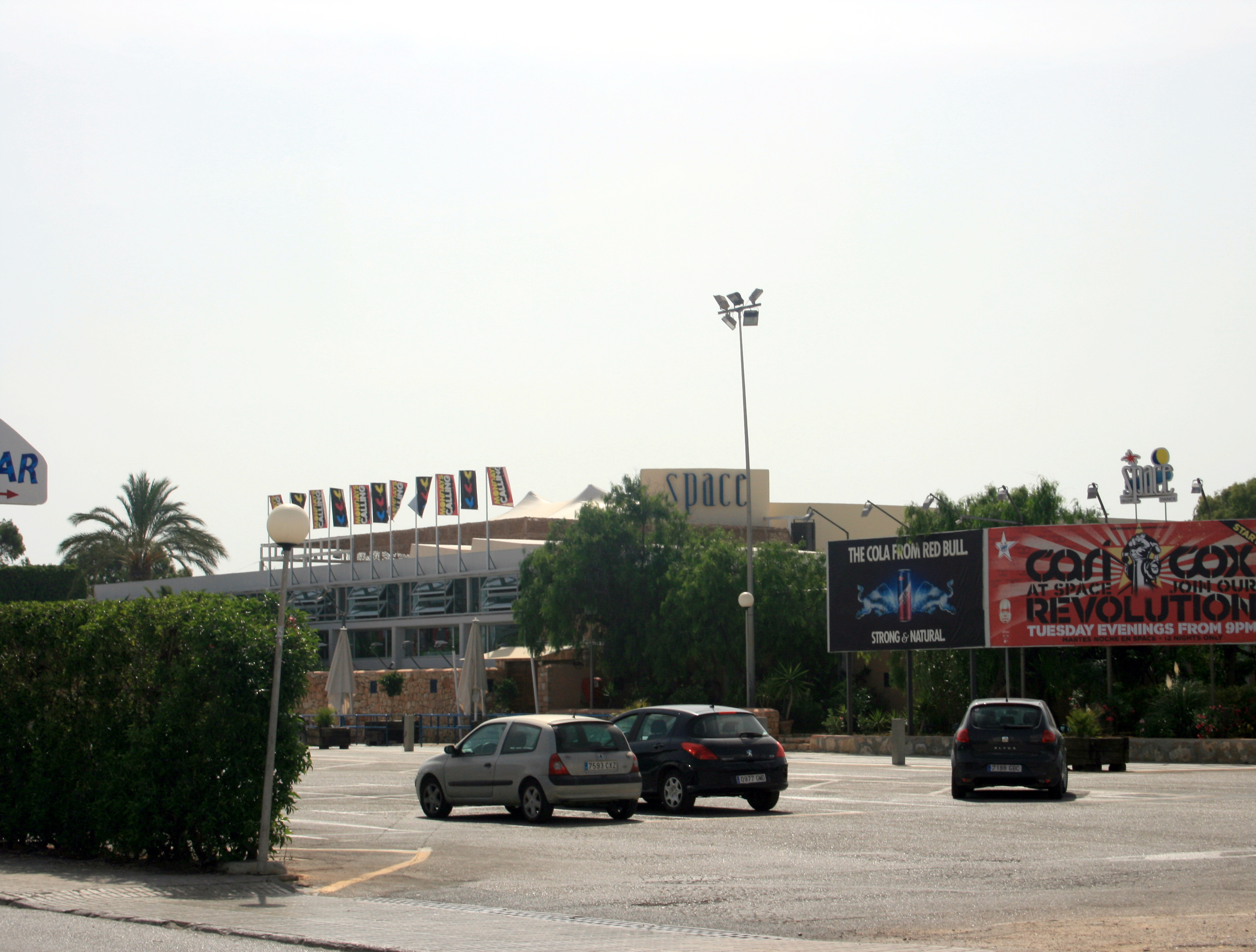
These reusable photographs show three stages of Space without borrowing rights-reserved press imagery: the daylight crowd, the booth as a visual centre and the mature closing-party production.


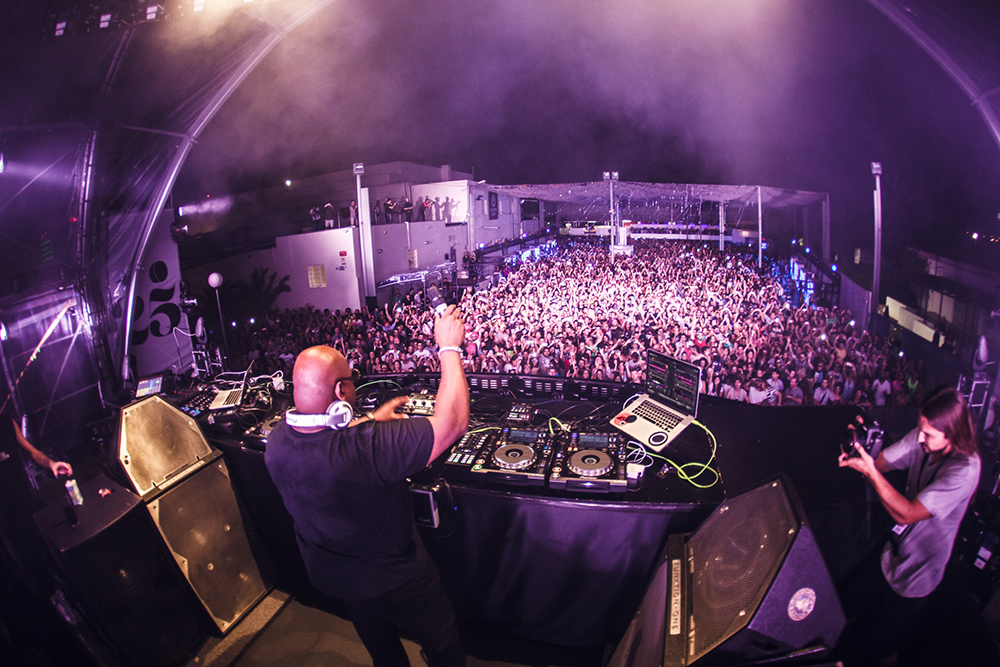
1998 is the archive beginning. 1999 is the booth story.
Club history often compresses memorable events into one perfect origin story. The Index first reaches Space with Cox in August 1998. Space’s own history places the famous change to the terrace booth during Radio 1’s Ibiza weekend the following summer.
For that 1999 weekend, a temporary booth was built at the end of the terrace instead of hiding the DJs behind the bar. Carl Cox, Mousse T and Boris Dlugosch played in a position that brought them closer to the crowd. The layout worked well enough to become permanent.
The broadcasts from that summer let the change feel immediate. Paul Oakenfold appears at Home at Space in July. Cox follows with two August programmes. The archive arrived in 1998; a year later, broadcasting helped change the room itself.
Sunday became a piece of architecture
By 1999, the Sunday session had grown into a 22-hour journey from eight in the morning until six the next day. Different rooms and different times became parts of one continuous event. A record that made sense in full sun did not have to serve the same purpose after midnight.
Pete Tong’s terrace recordings in 2001 and 2002 capture that idea in radio form. The later broadcast is billed from We Love Sundays on the Space Terrace, so the promoter, room and island become part of the way the music is introduced. The location is no longer background information. It is part of what listeners are being asked to imagine.
The connection also runs through the existing Pete Tong story, where the 2002 terrace set marks the point at which an Ibiza room became part of the programme’s editorial voice.
Radio learned to broadcast a whole club
At first, Space could be heard through one DJ. As the relationship grew, Radio 1 began treating the club as a world with several rooms, artists and moods. Pete Tong and Carl Cox shared the terrace in 2000. Five years later, a single programme carried a bill that ran from Tong and Cox to Above & Beyond, Erick Morillo, Judge Jules, Laurent Garnier, Fergie and Deep Dish.
That 2005 night should not be imagined as eight separate full-length Essential Mixes. It is one large broadcast built from an event. The distinction matters, but it does not need to interrupt the story. What the listener hears is Space becoming a platform large enough to hold several strands of Ibiza club culture at once.
John Digweed and Cox returned together in 2006. Later programmes move through the club’s mature superclub years, from a multi-artist Radio 1 night in 2011 to ENTER, We Love Space and the final seasons. The names on the flyer changed, while the room remained recognisable.
Start here
Three ways into Space
9 Aug 1998Carl Cox@ Space, Ibizaoriginal11 Aug 2002Pete Tong@ We Love Sundays, Space Terrace, Ibizaoriginal11 Oct 2014Carl CoxSpace Closing Fiesta, Ibiza (Recorded: 5 October 2014)original- The 1998 Carl Cox set catches Space before its mythology had fully settled.
- Pete Tong in 2002 turns a Sunday morning terrace into something radio listeners can picture.
- The 2014 Closing Fiesta shows the same club at the scale of an established institution.
Carl Cox made continuity visible
No DJ occupies the Space story quite like Carl Cox. The archive finds him there in the late 1990s, through the growth of his residency, at the 2014 Closing Fiesta and again during the final season. Later Classic programmes returned to those early performances after the club had gone.
His formal residency began in 2001 and lasted through the end of Space. Over those years it grew from six nights into a season-long institution. The relationship is explored in more depth in the Carl Cox story, but the key point here is simpler: one familiar figure lets us hear the room change around him.
Cox becomes a kind of measuring instrument. The late-1990s terrace feels exploratory. The residency years feel confident and expansive. By the closing seasons, the club is conscious of its own history.
The ending was real
Space closed in 2016 after Roselló’s 27-year era. The final announcement returned to the same memories that had defined the club: daytime dancing, the terrace, aircraft and Cox. These were not decorative details. They were the parts of the place that people carried away.
The building continued as a nightclub. Hï Ibiza opened on the site in 2017 with a different design, identity and business. Dance culture did not leave the address, but Space still ended. A map can make the history look continuous because the coordinates barely move. The name, people and institution tell a different story.
What the archive keeps
Photographs explain why Space looked different. The broadcasts explain why the difference mattered. The earliest Cox recordings preserve the terrace before every later memory had become fixed. The Sunday sessions show music changing with the daylight. The large 2005 programme catches the club operating as an entire broadcast system. The final seasons let a familiar room look back at itself.
Space put daylight into club culture. The archive kept the clock.
Sources and image rights
The venue chronology was checked against Space’s historical archive, Resident Advisor and The Guardian’s oral history with Pepe Roselló and Carl Cox. Broadcast dates and venue links come from the current Index. It contains 22 Space-connected programmes: 19 original visits and 3 later Classic returns. Shared event broadcasts are counted once, not once for every DJ on the bill. Every photograph reproduced here has a verified Creative Commons licence.
- Space: historical archive
- Space Ibiza: closing archive
- The Guardian: How we made Space Ibiza
- Resident Advisor: Space Ibiza, a brief history
- Hï Ibiza: the venue now occupying the former Space site
- Wikimedia Commons: Space Ibiza exterior, 2009
- Wikimedia Commons: Space crowd, 2000
- Wikimedia Commons: Space DJ booth, 2006
- Wikimedia Commons: Space closing party