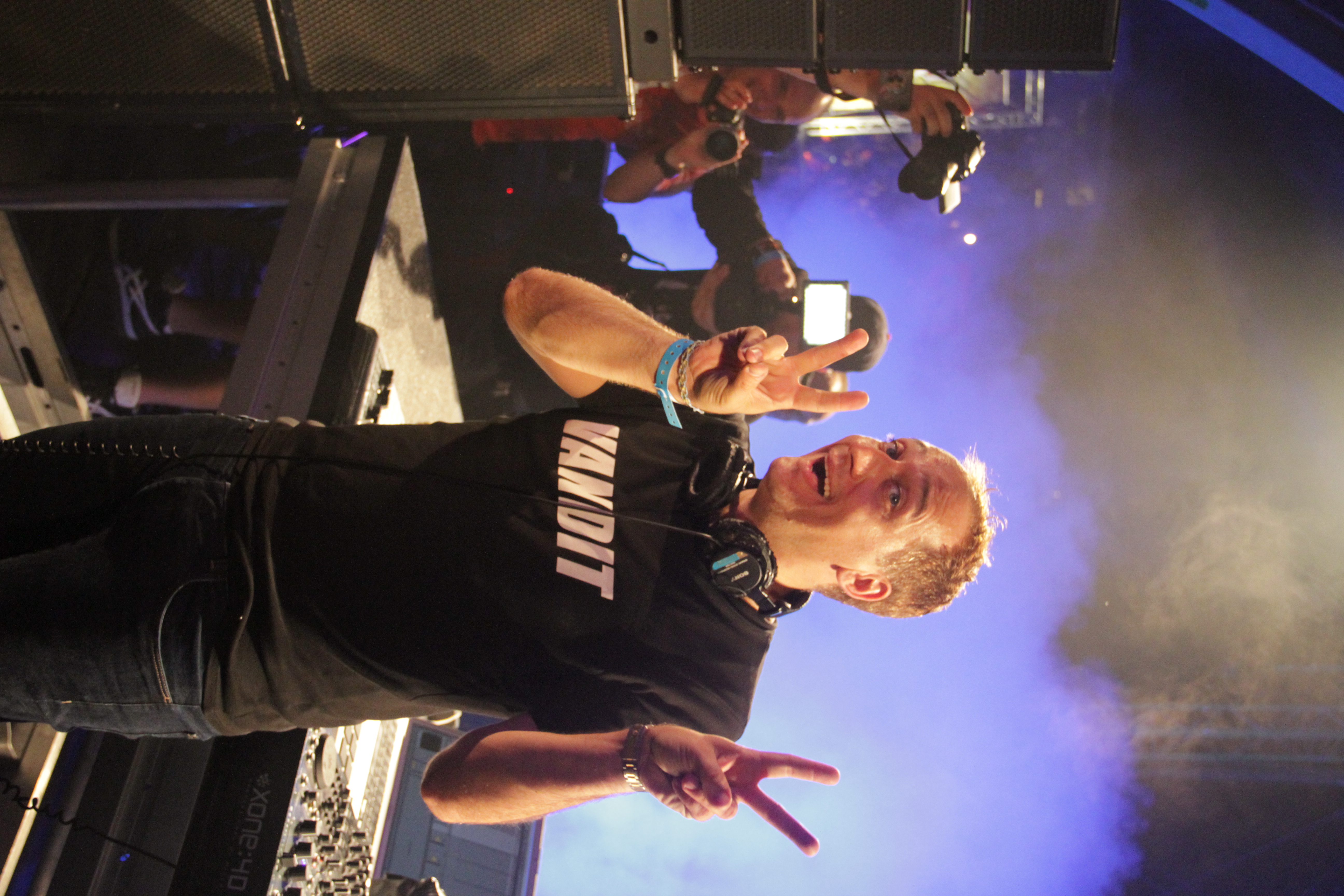
Paul van Dyk’s first Essential Mix does not charge straight at the finish line. It moves through Depeche Mode, L.S.G., Olive and BT with room to breathe, then places his own “Forbidden Fruit” and “Words” inside the flow. The energy is unmistakable. So is the restraint.
That April 1997 broadcast arrived just as trance was becoming a major international language. It would have been easy for a set from one of the sound’s defining artists to behave like a monument. Instead, it feels alert and unfinished, still testing where melody can lead and how much pressure a long transition can hold.
The precision matters, but precision is not the whole point. Across van Dyk’s career, control has been a way of creating openness. The records are carefully placed so that the listener can feel scale, release and possibility.
The radio came through the wall
Van Dyk grew up as Matthias Paul in East Berlin. Western radio crossed a border that people could not. He has described listening to those stations as forbidden but ordinary, something he and his friends did anyway. Without easy access to record shops or music magazines, sound reached him before image, celebrity or scene etiquette.
That history can make the language around his music sound too neat. Freedom, movement and the horizon are not marketing decorations in his story. They are connected to the physical limits of childhood. When electronic music arrived through the radio, its lack of instruction was part of its power. It did not tell the listener what to picture. It left a space to enter.
E-Werk gave emotion a frame
After the Berlin Wall fell, the city’s new clubs turned abandoned and repurposed spaces into laboratories. Van Dyk became closely associated with E-Werk, the former electrical substation whose vast rooms helped define Berlin nightlife in the 1990s. The setting suited a sound that could be forceful without feeling boxed in.
His records from that decade joined hard rhythmic discipline to long, bright melodic lines. “For an Angel” became the obvious emblem, but the wider method was already there: tension first, then a release made more powerful by patience. The emotion did not sit on top of the machinery. It came from how the machinery moved.
The 1997 mix refuses the stereotype
Listening through the documented running order now, the surprise is how little it resembles a frozen idea of classic trance. Depeche Mode’s “It’s No Good” appears near the beginning. L.S.G.’s “Netherworld”, Blue Amazon, Olive and Tilt shape the middle. BT’s “Flaming June” helps open the final stretch before van Dyk’s own productions arrive.
The records are melodic, but they are not soft. They keep changing density and direction. The mix is persuasive because it does not need to announce a genre every few minutes. It trusts pace, atmosphere and the listener’s memory.
The archive becomes a map
The Love Parade story follows the public gathering and surrounding club nights behind his 2002 Berlin connection.
The later broadcasts move out of the studio and into the places where that sound had become public culture. In April 2000, the archive finds van Dyk at Home in London. By December he is at the Casino in Berlin. In July 2002, he is heard from the Berlin Love Parade, where the scale of the crowd becomes part of the recording’s meaning.
A 2003 studio return and a 2006 Coloursfest recording show two sides of the same practice: the DJ as patient editor and the DJ as a figure inside a very large room. The setting changes. The commitment to shape does not.
Start here
Three Paul van Dyk mixes, three kinds of space
20 Apr 1997Paul van DykEssential Mixoriginal14 Jul 2002Paul Van Dyk@ Berlin Love Paradeoriginal26 Sept 2009Paul Van DykEnd Of Summer Mixoriginal- The 1997 debut shows the range and patience behind the signature sound.
- The 2002 Love Parade recording places that sound inside the city that formed it.
- The 2009 End of Summer mix opens quietly, then lets the dancefloor return by degrees.
A label becomes an ecosystem
VANDIT Records extended the same sensibility beyond one artist’s releases. The label gave van Dyk a home for his own work and a platform for other producers, helping melodic, driving trance travel without losing its connection to Berlin. VONYC Sessions later made radio a weekly part of that ecosystem.
The important word is not brand but continuity. Records, label, radio and touring feed one another. New music enters the programme, becomes part of a set, reaches a crowd and returns to the next broadcast with a different history attached.
Shared broadcasts show the scale of the culture
Nine more archive records place van Dyk inside larger bills. He appears with Pete Tong at Oxford Sound City in 1997 and Turnmills in 1999. Homelands, the Love Parade, Gatecrasher, Global Gathering, Planet Love and Coloursfest connect him to line-ups that also include names such as Sasha, John Digweed, Sven Väth, David Guetta and Groove Armada.
Those programmes are part of his Essential Mix history, but they are not rewritten here as solo sets. Their original billing is the point. It shows how radio tried to hold an entire night, festival or scene inside one broadcast.


The 2009 mix opens the windows
The End of Summer mix from September 2009 begins almost at rest. Aural Float, Trentemøller and a soft remix of van Dyk’s “White Lies” stretch the opening into a long inhale. The familiar pulse returns gradually rather than arriving as an order.
By the closing run, the set has found Giuseppe Ottaviani, Simon Patterson, “The Age of Love”, “Big Sky”, “Home” and “For an Angel”. The famous records land differently because the first part has made room for them. This is not a retreat from the dancefloor. It is a reminder that a peak only works when the set has somewhere to climb from.
Precision is not rigidity
Van Dyk is often described through technical control: the clean blend, the long build, the reliable sense of direction. All of that is true, but it can make the experience sound colder than it is. The craft is there to protect the emotional line, not to display itself.
This is why the 1997 and 2009 mixes still speak to each other. One arrives at the height of a sound becoming visible. The other looks back from a point of global fame. Both understand that intensity becomes more moving when it has contrast around it.
After 2016, continuity changed
In February 2016, van Dyk fell through an opening in a festival stage in Utrecht and sustained life-threatening brain and spinal injuries. Recovery meant learning ordinary physical actions again before a return to performance was possible. The fact that his career continued cannot be reduced to a triumphant comeback line. It changed the meaning of continuity itself.
Later interviews are candid about pain, vulnerability and the work of recovery. In that light, the discipline heard across the archive feels less like perfectionism and more like persistence: an insistence on rebuilding a path through sound, one decision at a time.
What the archive keeps
Seven direct original broadcasts run from 1997 to 2009. Two Classic listings in 2022 and 2024 return to the 2007 Global Gathering programme, while nine shared records preserve the event culture around the solo sets. The distinctions matter, but they lead to a human story.
A child hears another world through a wall. A young DJ finds a frame for that feeling in Berlin’s clubs. The music grows large enough for parades and festivals, then quiet enough to begin a radio mix at the edge of silence. Paul van Dyk’s great subject has always been freedom. His particular gift was to show how much care it can take to make freedom audible.
Sources and method
Career history was checked against Paul van Dyk’s official site, Recording Academy biography, Resident Advisor and contemporary interviews. Injury and recovery context was checked against DJ Mag reporting and interview material. Broadcast counts and descriptions come directly from the Essential Mix Index dataset and documented tracklists. Shared event credits remain distinct from direct mixes.