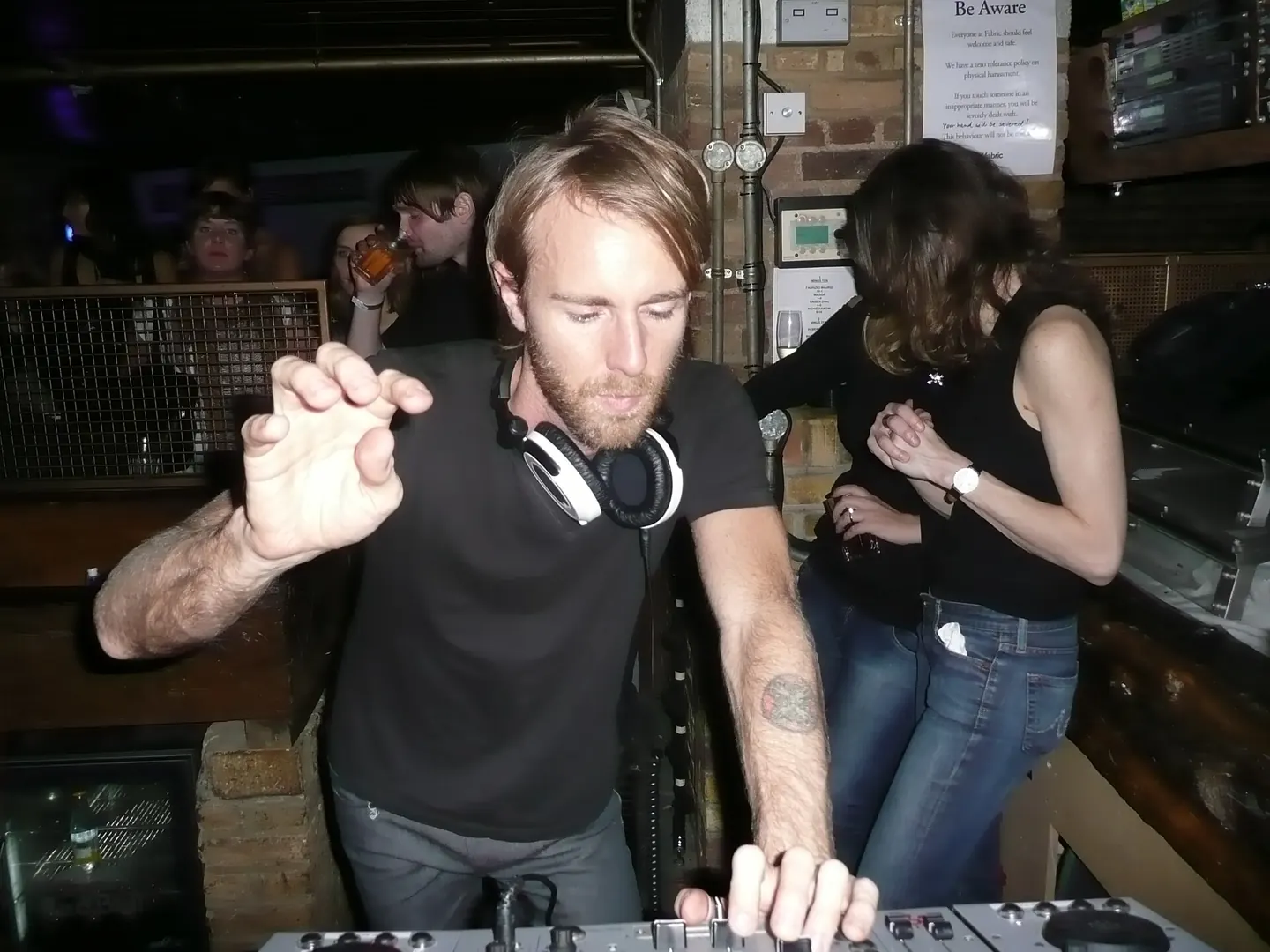
When Richie Hawtin appeared on the Essential Mix on 22 April 2001, Pete Tong introduced him by describing the equipment. Recorded at Tribal Sessions in Sankey’s Soap, Manchester, it was Hawtin’s decks, effects and 909 show. The machinery had become part of the reason to hear him.
The documented tracklist begins with Xpansul & Daweed, then moves through Mr. G, Olav Basoski, Jamie Anderson and Bad Boy Bill before concentrating on harder techno. DJ Shufflemaster, Ben Sims, Samuel L. Session and Rino Cerrone appear later. Thirty-three entries occupy the programme.
That number cannot establish every loop, effect or live intervention. The introduction does establish that the hardware was part of the performance. Hawtin was expanding the choices a DJ could make while records played.
Detroit was across the river
Born in England and raised in the Windsor area of Ontario, Hawtin grew up close to Detroit, with an international border between them. His father worked in robotics and introduced him to electronic instruments and recording equipment. Kraftwerk and Tangerine Dream at home met the broader musical possibilities of Detroit radio.
The Electrifying Mojo’s broadcasts could connect European electronics with funk, soul, hip-hop and new American dance records. Hawtin entered a culture shaped substantially by Black American artists, including Juan Atkins, Derrick May and Kevin Saunderson. His later innovations belong within that history.
Firsthand accounts by Hawtin and John Acquaviva describe the clubs and connections behind their early work. In 1990, they established Plus 8 Records, making Windsor another point in techno’s international network. The label allowed studio ideas to reach a dancefloor without waiting for a major company’s approval.
Plastikman finds what can be removed
By 1993, Hawtin was developing distinct recording identities. F.U.S.E.’s Dimension Intrusion appeared in Warp’s Artificial Intelligence series. Plastikman pursued an especially economical language of acid basslines, sharp percussion, repetition and space.
Records such as “Spastik” and Sheet One made small changes consequential. With fewer elements competing for attention, a rhythmic shift could reorganise the whole experience. Repetition became a compositional tool.
The discipline of those recordings sits beside the flexibility of Hawtin’s developing DJ technique. One project carefully fixes a small number of elements; the other allows existing material to change during performance. That tension helps explain the records and broadcasts that followed.
The DJ set becomes something to reconstruct
The title of his 1999 mix album Decks, EFX & 909 described the combination of turntables, effects and a Roland drum machine. Additional percussion and processing allowed finished records to become ingredients in a changing arrangement.
DE9: Closer to the Edit in 2001 and DE9: Transitions in 2005 investigated that process through loops and fragments. In his Ableton interview, Hawtin described the connection between editing records into new compositions and the possibilities opening up in performance software.
A rhythmic phrase could be isolated, repeated and combined with fragments from elsewhere. The resulting sequence might retain a record’s character while using little of its original arrangement. The DJ was taking on some of the work of an arranger.
Manchester puts the method in a room
The April 2001 broadcast falls between the earlier hardware-led mix album and the increasingly detailed reconstruction of DE9. Its running order moves through different kinds of machine funk, from house-related grooves towards industrial textures and harder techno.
Samuel L. Session appears repeatedly, with “A Bastards Work Is Never Done”, “Centrafrique”, “Into The Groove” and “Body N’ Soul”. Nitzer Ebb versus Thomas P. Heckmann appears near the end, before the final Ben Sims selection.
The list documents records and order. Tong’s introduction supplies the equipment context. Keeping those types of evidence separate makes the recording more useful: the programme captures a developing performance approach without pretending its tracklist is a complete technical account.
The afterparty runs on another clock
On 10 November 2002, Sven Väth and Hawtin shared an Essential Mix built around the club and the afterparty. Väth’s first hour drew on Amnesia’s dancefloor; Hawtin took the second towards a smaller, less forceful atmosphere.
The documented selections move from Väth’s Thomas Schumacher, Tony Rohr and Scan X towards Dettinger, Jeff Samuel, Robag Wruhme and Mathew Jonson in Hawtin’s section. The two halves have different jobs. Hawtin’s contribution becomes more revealing because it follows Väth’s.
This is one shared programme, later revisited as a Classic on 10 May 2020. Splitting the original into two solo episodes would lose the concept that gives the sequence its meaning.
A collaboration keeps the smaller changes audible
The 10 July 2005 programme connects Hawtin and Ricardo Villalobos to T in the Park. Their documented segment includes Pascal FEOS, Traffic Signs, Colder, Koljah, Argy and Audio Werner. Small rhythmic changes, understated basslines and unusual textures form a different vocabulary from Manchester’s harder material.
The complete Index programme is billed DJ Sneak, Richie Hawtin & Ricardo Villalobos. The Hawtin–Villalobos segment belongs inside that larger record. Its running order does not assign every selection or intervention to one DJ, and the article does not turn their contribution into a separate solo broadcast.
Digital records change what can be carried
Final Scratch brought another practical change. Digital audio files could be controlled through turntables, allowing a computer-based collection to retain a familiar physical interface. Contemporary reporting in 2001 caught Hawtin using a technology that challenged established habits around vinyl.
For DJs, records were also a culture: shops, scarce releases, physical technique and collections assembled over years. New tools could widen access while making the performer’s decisions harder for an audience to see. A laptop or controller does not reveal its workings as readily as a struck drum.
The freedom offered by the equipment created another artistic problem. How could a listener understand what was happening behind it?
Ibiza becomes a larger experiment
Hawtin launched ENTER. at Space Ibiza in 2012. Music, visual design, technology and Japanese sake became parts of a deliberately organised club experience. Different rooms could support different musical directions, while interactive installations invited visitors into parts of the sound and light.
The regular residency ended after the 2015 season. Within the archive, the directly billed 1 August 2014 programme preserves a specific ENTER. connection. It belongs beside the earlier Cocoon-inspired afterparty and the wider Ibiza event bills without making those occasions interchangeable.
Berlin and Los Angeles change the repertoire
The Watergate selection published by Pete Tong includes Adam Beyer, Pig&Dan, Hot Since 82, Maetrik, Woo York and Technasia. It connects Hawtin to a different contemporary repertoire from the one surrounding him in 2001.
The dates need care. MixesDB identifies a Watergate performance on 25 August 2012 and an Essential Mix broadcast on 1 September. Tong’s own August post uses 25 August in its heading. The Index’s 1 September record is billed Avicii, Loadstar & Richie Hawtin; it is retained as a shared programme, with the Watergate segment distinguished from the other artists’ Creamfields contributions.
On 30 January 2016, Radio 1 broadcast Hawtin from Exchange in Los Angeles, recorded on 22 January. The documented running order includes Andres Campo, Mladen Tomic, KH, Pig&Dan, Huxley & J.Phlip and Joy Orbison, alongside incompletely identified material. Those gaps are limits in the documentation, rather than permission to invent missing records or techniques.
CLOSE makes the work visible
Hawtin’s CLOSE project debuted at Coachella in April 2017. Cameras and projections connected his physical actions to electronic performance. Visual artist Itaru Yasuda’s project documentation describes the real-time effects and camera systems used across the shows.
The idea addressed a question that had followed the digital tools: how does somebody watching know what is being performed? Exposing the relationship between hands, instruments and sound offered one answer. Yasuda’s CLOSE documentation preserves that visual history; its performance photography remains at the source.
The instrument is only part of the story
The current Index contains fifteen Hawtin-credited records: five directly billed records and ten shared or event records. The direct group contains three originals, one replay and one Classic. That is a catalogue count of broadcasts, not fifteen separate solo performances.
Plastikman demonstrated how much could happen with few elements. Manchester made additional hardware part of a DJ performance. The afterparty with Väth changed the scale and pacing of a night. CLOSE tried to make electronic decisions visible.
There is a useful parallel with Andrew Weatherall’s radical remixes: a recording can remain open to interpretation after it leaves the studio. Hawtin’s changing tools made that possibility central to his performance practice. Their value depended on the music he made with them.
Listen for
In Manchester, follow the shift from groove-oriented selections to harder rhythmic pressure. In 2002, compare the musical tasks assigned to the club and afterparty halves. In Los Angeles, examine how the repertoire has changed while remembering that a tracklist cannot expose every performance decision.
Start here
Three ways into Richie Hawtin
Manchester: the machinery becomes part of the introduction. Follow the 33-entry running order from groove-oriented material into harder techno; the presenter identifies the decks, effects and 909 format.
The club and the afterparty: Väth and Hawtin have different musical tasks inside one programme. Hear the relationship between the halves, while preserving both artists’ credit.
Los Angeles: a later repertoire and a different broadcast setting. The Exchange performance, recorded on 22 January, provides a useful comparison with Manchester fifteen years earlier.
Sources and method
The connected archive uses the current Index’s exact stored records and historical artist billing. Direct credits, shared programmes, replays and Classics are counted separately. A later broadcast of an existing set is not another original performance. Musical descriptions follow published running orders and programme documentation, rather than a claimed fresh audition of every recording.
- Essential Mixipedia: Manchester, 2001, and presenter introduction
- Essential Mixipedia: Sven Väth and Richie Hawtin, 2002
- Essential Mixipedia: Hawtin and Villalobos’s 2005 segment
- Pete Tong: Watergate running order, published in August 2012
- MixesDB: Watergate recording and broadcast dates
- MixesDB: Exchange, Los Angeles, and the 2016 broadcast
- Exclaim!: firsthand Plus 8 history with Hawtin and Acquaviva
- Red Bull Music Academy: Richie Hawtin lecture, 2013
- Ableton: Hawtin on loops, effects and live performance
- Wired: contemporary Final Scratch reporting, 2001
- Space Ibiza: Hawtin on ENTER.
- Resident Advisor: ENTER. ends its regular Ibiza residency
- Itaru Yasuda: firsthand CLOSE visual-system documentation
The photograph’s source and licence are linked in its caption. Corrections with supporting evidence are welcome at moderator@essentialmixindex.com.